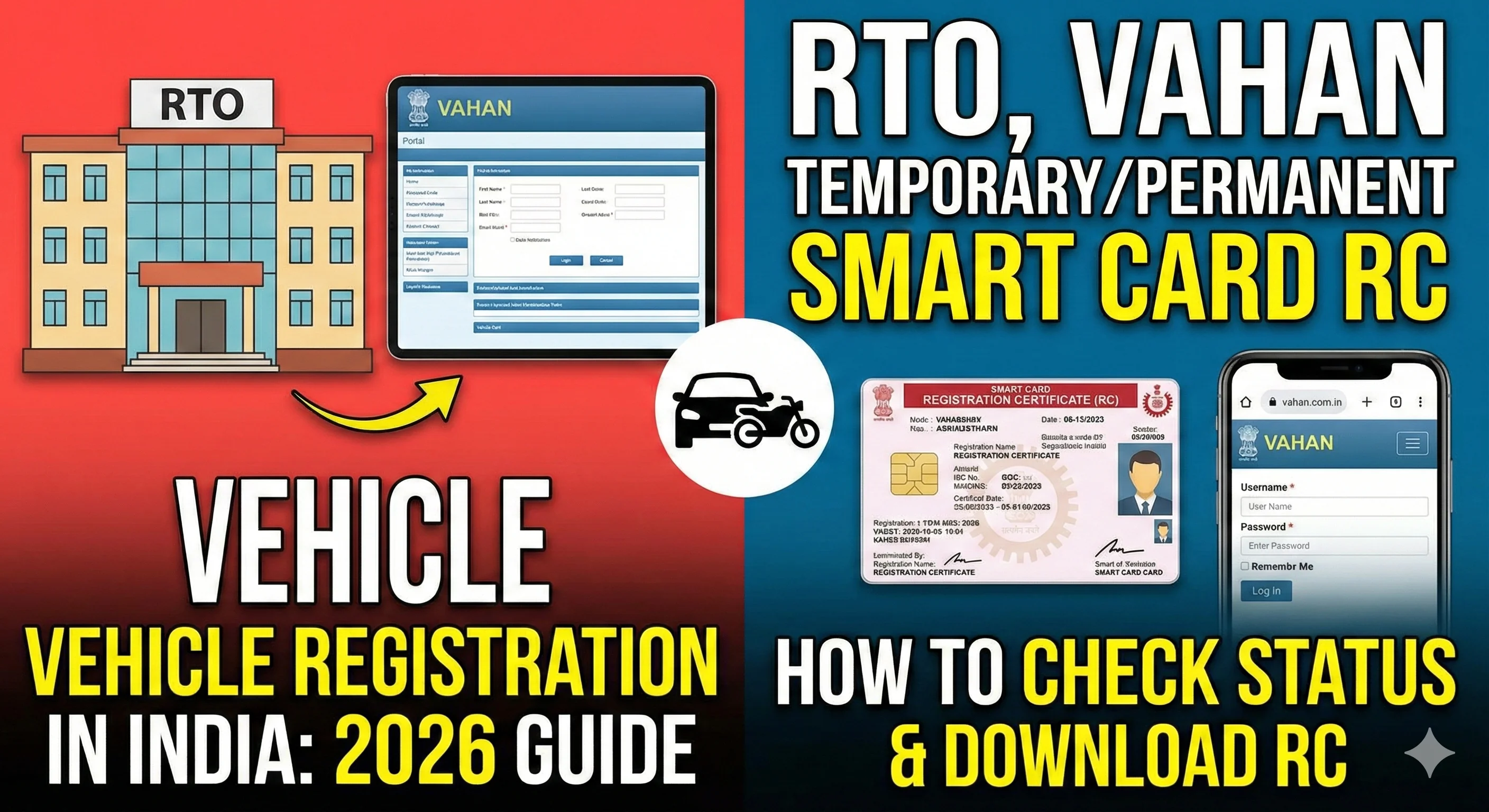
What Is Vehicle Registration?
Vehicle registration is the official process through which a vehicle is recorded in the government’s transport database and assigned a unique registration number. This registration:
- Legally identifies the vehicle
- Links the vehicle to its owner
- Allows it to operate on public roads
- Stores details in the VAHAN database
Without valid registration, a vehicle cannot legally be driven on Indian roads.
To verify your registration details anytime, you can check RC details here: 👉 RC Details
Legal Framework Behind Vehicle Registration
The vehicle registration process in India is governed by:
- Motor Vehicles Act, 1988
- Central Motor Vehicle Rules
- Ministry of Road Transport and Highways (MoRTH)
Every motor vehicle must:
- Be registered within 7 days of purchase
- Display a valid number plate
- Maintain updated ownership records
Failure to register can lead to penalties, fines, or even vehicle seizure.
You can track your vehicle registration progress through: 👉 RC Status
Step-by-Step Vehicle Registration Process in India
Step 1: Vehicle Purchase
When you buy a new vehicle:
- Dealer collects buyer KYC documents
- Temporary registration may be issued
- Road tax is calculated
Documents required include:
- Aadhaar Card
- Address proof
- PAN Card
- Invoice copy
- Insurance policy
Step 2: Temporary Registration (If Applicable)
Temporary registration is usually:
- Valid for around 30 days
- Issued by dealer or RTO
- Allows you to drive before permanent registration is completed
You can learn more about temporary registration here: 👉 Temporary RC
Step 3: Submission to RTO
The dealer or buyer submits:
- Form 20 (Application for registration)
- Insurance copy
- Invoice
- Address proof
- Pollution certificate (if required)
The RTO then:
- Verifies documents
- Inspects vehicle (if needed)
- Confirms chassis and engine number
Step 4: Registration Number Assignment
After document verification, the RTO assigns a registration number.
The format typically includes:
- State Code (e.g., MH, DL, GJ)
- RTO Code
- Series
- Unique number
Example: MH12AB1234
To understand number formats in detail, check: 👉 RC Particulars
Step 5: Data Entry into VAHAN Database
Once approved, the vehicle details are uploaded into the centralized VAHAN system.
The VAHAN database stores:
- Registration number
- Owner details
- Vehicle specifications
- Insurance validity
- Hypothecation details
- Registration validity
You can verify official registration data via: 👉 RC Verification
Step 6: RC Smart Card Generation
Most states now issue a Smart Card RC instead of a paper booklet. The smart card contains:
- Owner name
- Engine number
- Chassis number
- Fuel type
- Vehicle class
- Validity
If you want to understand smart card RC better, read: 👉 RC Smart Card
What Happens After Registration?
Once registration is complete:
- ✔ Registration number becomes permanent
- ✔ RC is generated
- ✔ Data is available in VAHAN
- ✔ Vehicle becomes legally operable
You can:
- Check RC status
- Download RC PDF
- Verify vehicle details
- Track RC dispatch status
To download digital copy anytime, visit: 👉 RC Download
Temporary vs Permanent Registration
Temporary registration is:
- Short-term
- Issued immediately
- Allows initial movement
Permanent registration:
- Is usually valid for 15 years (private vehicles)
- Is recorded in VAHAN
- Is required for resale and insurance
After 15 years, you must apply for renewal at: 👉 RC Renewal
How Long Does Vehicle Registration Take?
Typical timeline:
- Dealer submission: 1–3 days
- RTO processing: 5–10 days
- Smart card printing: 5–7 days
- Dispatch: 5–10 days
Delays may occur due to:
- Document mismatch
- RTO workload
- Inspection issues
You can track real-time status at: 👉 RC Status
How to Check Vehicle Registration Status Online
To check status:
- Visit official vehicle services portal
- Enter registration number
- Verify OTP
- View registration status
Status may show:
- Application received
- Under process
- Approved
- Printed
- Dispatched
Use official tracking here: 👉 RC Status
Common Issues in Vehicle Registration
1. Name Spelling Error
If your name is printed incorrectly on RC, use correction service: 👉 RC Correction
2. Ownership Transfer Required
When selling or buying a used vehicle, apply for transfer here: 👉 RC Transfer
3. Lost RC
If RC is lost, apply for duplicate here: 👉 Duplicate RC
4. Loan Cleared (Hypothecation Removal)
After closing vehicle loan, use service: 👉 RC Hypothecation Removal
Role of VAHAN in Vehicle Registration Process
The VAHAN system is India’s centralized vehicle registry. It ensures:
- Unified national database
- Real-time updates
- Inter-state transfer tracking
- Smart card integration
- Digital verification
All RTO offices update records into VAHAN.
That’s why checking your vehicle registration online reflects real-time data.
Why Vehicle Registration Is Important
Vehicle registration ensures:
- ✔ Legal road usage
- ✔ Proof of ownership
- ✔ Insurance claim eligibility
- ✔ Easy resale process
- ✔ Loan documentation compliance
- ✔ Transfer of ownership
Without valid registration:
- Heavy penalties may apply
- Insurance claims may be rejected
- Vehicle cannot be legally transferred
Digital Transformation in 2026
Vehicle registration in 2026 is now:
- Fully digitized
- Linked with Aadhaar
- Connected to VAHAN 4
- Integrated with smart card issuance
- Trackable online
Users can:
- Verify RC details instantly
- Download RC PDF
- Check vehicle owner information
- Track application status
- Access digital RC anytime
Access digital RC anytime through: 👉 RC Download
Frequently Asked Questions
What is the vehicle registration process in India?
It is the legal procedure of registering a vehicle with the RTO to obtain a unique registration number and Registration Certificate (RC).
How many days does registration take?
Usually 7–15 days depending on RTO workload.
Is temporary registration mandatory?
Yes, if permanent registration is not completed immediately.
Can I check registration status online?
Yes, through official RC status portal.
Is RC mandatory?
Yes, driving without RC attracts penalties.
Final Summary
The vehicle registration process in India involves document submission, RTO verification, registration number assignment, VAHAN database entry, and RC smart card issuance.
Every vehicle must be registered before it can be legally used on public roads.
After successful registration, you can:
- Check RC details
- Track RC status
- Download RC copy
- Apply for renewal
- Transfer ownership
- Verify registration online
For quick digital access to your registration certificate, use: 👉 RC Download